Become A Donation

Become A Donation
Lorem Ipsum is simply dummy text of the printing and typesetting industry.

Contact Info

684 West College St. Sun City, United States America, 064781.

(+55) 654 - 545 - 1235

info@charety.com

History of the church

About Us

St. Kevin's Parish

We wish you “a hundred thousand welcomes”!

This is a building where the church gathers to pray, to hear the Word of God, and to share in the Eucharist.

The building expresses something of our faith. We are Catholic Christians. Perhaps you share our faith in God; perhaps not. Either way, we hope that you will find your visit interesting; and that you may know us a little better. As you visit, please take some quiet moments in reflection or prayer. As you visit, be aware of others present who may be taking such quiet moments. When any service is taking place, please postpone your sight-seeing until afterwards. 

Glendalough

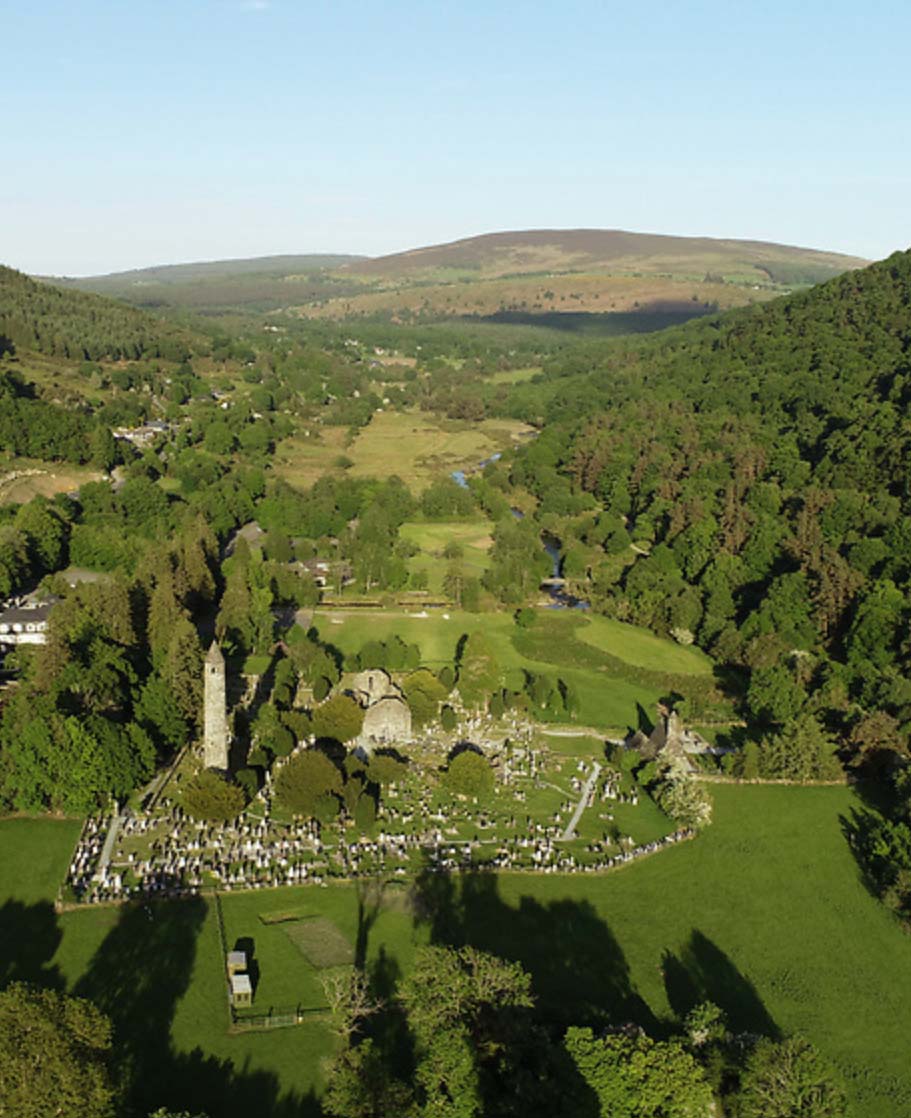
The Valley of Two Lakes. Here St Kevin came in the sixth century for a life of prayer. Many gathered around him, and a monastic city grew in the valley. Kevin died about the year 618. Glendalough became a place of pilgrimage in early Christian Ireland. The Annals of Clonmacnoise record its destruction in 1398.

You can visit the valley today and walk in through the gateway and around the many buildings of the city. The valley was and is known locally as “The Seven Churches”, a name given on old maps; or simply “The Churches”. The parish church of St Kevin in use today is located in the townland of Brockagh, near Laragh, to the east of Glendalough. There are many publications about the monastic city.

The Building Where we meet

The foundation stone was laid on the feast of St. Kevin, 3 June 1846. It was blessed by Fr Theobald Matthew, well known at the time as an “Apostle of Temperance” in Ireland, and was laid by Peter Kelly. ‘Through the liberality of a Protestant gentleman of the district, Captain Hugo, a site has been obtained; and by the munificence of Andrew Byrne of Croneybyrne, and of Peter Kelly of Little Britain Street. Dublin, the single-minded pastor, Rev. Eugene Clarke, has been enabled. to commence a church.” (Irish Ecclesiastical Register, 1847) This publication reported in 1851: “The solemn dedication will take place on the approaching festival of the patron saint, the 3rd of June.”

It was a time of considerable development in the Catholic Church in Ireland. Catholic Emancipation in 1829 saw the repeal of many of the laws adversely affected the life of the church. This followed gradual relaxation over the previous few decades. From 1810, for some years, St Kevin’s church (“St Kevin’s Kitchen”) in the monastic city was used as a Catholic church, until it was prohibited by the legal owners of the site.

The architect of our church, James Joseph McCarthy (1817- 1882) was an admirer of the architect Pugin, and of the Irish tradition. This was a very difficult time for the people of Ireland. From 1845 to 1847 were the worst years of famine as a result ofa blight which destroyed the potato crop, on which the population depended. It is hard lo imagine how the people of the area could have undertaken the building of a church at this time, but they did. Keep this in mind as you visit our church. Remember the proverb: “Let those who drink the water not forget those who dug the well.” The church building has undergone extensive restoration 1999 – 2001. Co. Wicklow is known for its granite, which you will see in the walls and buttresses of the building.

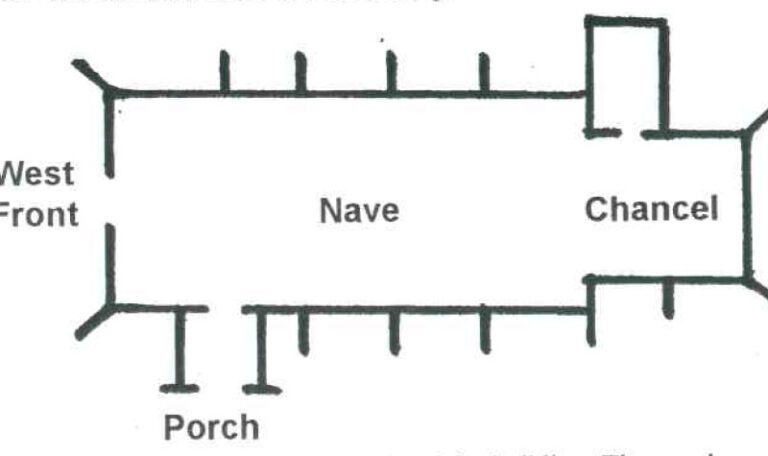
The “Nave” is the main body of the building. The word comes from the Latin “Na vis”, a ship. It recalls Noah’s Ark, the story in the Book of Genesis (at the start of the Bible), chapters 6 to 9: a story of evil and death seeming to possess the world, but God acts to bring us through to new life. It recalls also the stories of Jesus teaching his followers from a boat (St Matthew·s Gospel, Chapter 13), and his saving them when they seemed lost (Matthew 8:23). You may notice the custom of “orientation” in churches: The altar table placed at the Eat end (the Orient), to remind us that Jesus. in rising from the dead, is our “Rising Son” of God, who is the light of the world (St John’s Chapter I).

What you see around the church

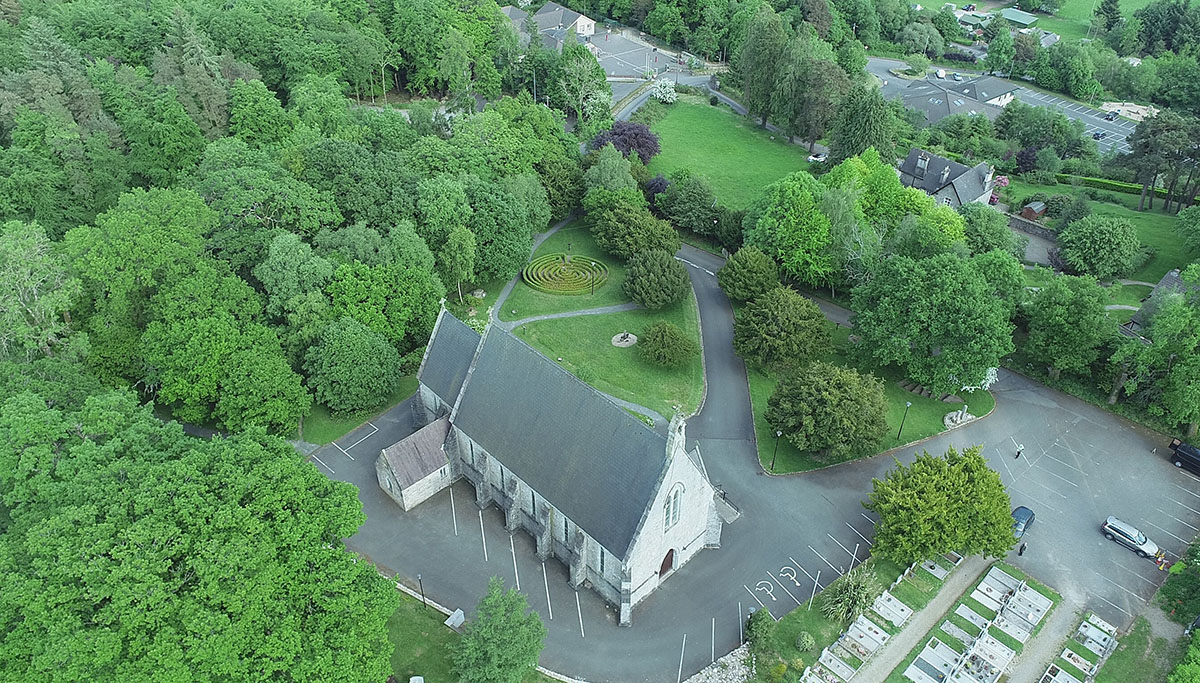
As you enter the grounds of the church, you see the church building uphill on the right. To the left is the Parochial House and “Suaimhneas Chaoimhln” (The Tranquillity of Kevin). It is a development of small simple houses we know as “Cillins” (cells) for the use of those who wish to have a place of prayer, reflection, and spiritual guidance. The Irish word for “Church” is “Cill”, which you will find in many place-names – Kildare. Kilkenny, etc.

Before you enter the porch, you see a statue of St Therese of Lisieux ( 1873-1897) opposite. Therese was a Carmelite nun in France who was unknown during her lifetime. but has since become renowned for her simplicity and holiness through her writings.

At the west front of the church is a “Lourdes grotto”, recalling an apparition of Mary (mother of Jesus Christ) to St Bernadette Soubirous in 1858 al Lourdes in France. and a modem place of pilgrimage.

Jesus Christ is a central figure in the church. and you will see pictures and statues around the church.

Entering the Church

Above the door to the porch is a statue representing St Kevin of Glendalough, one of the outstanding figures of the early Irish church. He was abbot of the monastery (a place of prayer) at Glendalough. He is shown dressed in the clothing or vestments used for our worship celebrations.

He has the crozier (stall) and mitre (head-wear) of an abbot. The bird (sec statue in the porch also) recalls an ancient tradition of Kevin being so lost in prayer that a bird came and built a nest in his hand: Kevin remained in prayer until the young hatched! On the left hand side of the entrance arch is again a representation of an abbot: on the right is a king. You may get to visit Reefert Church in Glcndalough (Ríoghfheart: a royal cemetery). burial place of the  of the chieftains of the O’Toole’s. A later abbot of Glendalough was St Laurence O’Toole (1128-1180).

As you enter the porch, you see two water fonts – bowls containing water, to remind us of the water of Baptism. the beginning of our life as Christians.

Facing you as you go through the inner door is an icon (Greek for “image”) of Our Lady of Tenderness. Mary holds her son. Jesus. The Greek letters MP OX stand for Maria Thcotokos: Mary, mother of God. The letters IS XS stand for Jesus Christ.

Look now to your right, towards the Chancel, where the Lectern and Altar Table are situated. Along the walls on either side is a set of paintings by George Colley, which we usually call the “Stations of the Cross”. These are 14 stations or stopping places on the journey of Jesus to his death on the cross. We follow these in order. journeying in spirit with Jesus. We do this. not to focus on the cruelty of his death or the cruelty in our world today, but to take to heart that not all the evil in the world could overcome the love of God that we find in Jesus. May we find the same in ourselves!

Why do people light candles or lamps in the church?

It’s like a prayer in action. Prayer need not be just words, we use gestures too. We pray because we are members of the Church, the living Body of Christ in our world, and we want to bring his light to the world. We are not alone: the light from many small candles unites to strengthen the light. When I light a candle in prayer and go away, another coming afterwards can know I have been there and may be encouraged by it. 

About the Statues & Pictures

 There are statues and pictures around our parish church. We do not pray to statues or pictures. As you might use a photograph or memento of someone you love, these are there to remind us of Jesus Christ and of his many followers, to encourage us to follow him more faithfully.

But there’s more. Together, we are united in the “Communion of Saints” – if we are alive to God, death does not separate us from those of our “communion” who have died. Pictures, icons, and statues can help us come into the presence of the living God along with them. Hesus Christ is always interceding for us. So too, those who are living in Jesus can pray and intercede for one another.

The Icons of St. Kevin & St. Laurence

These are two icons of two saints particularly associated with Glendalough. We remember them as people who lived their lives here a long time ago; but even more important,  as people who are living members of the Communion of Saints” with us. With them, we are one in Jesus Christ. See whether the icons will speak to you. Take a little time in silent contemplation, and let the eternal break through to you!

Facing you on the right side of the Sanctuary is an icon of St Kevin ‘”written” by Sr. Aloysius McVeigh. She comments: The icon suggests · St. Kevin’s preference for the life of solitude, penance and prayer of a hermit, and also his affinity with nature and his love for animals and birds. The well-known story of the black bird in his hand is a verbal image of his reverence for creation, while the fawn at St. Kevin’s feet is a symbol of his own gentle peaceful nature. The stole that Kevin wears over his monk’s garb, as well as the open books of the scriptures, indicates that Kevin was also an ordained priest called to ministry. To obey that calling he had to give up the peace and poetry of his beloved retreat.

The miracles and marvels recounted in the ancient manuscripts of Kevin’s life were very probably parables containing deeper truths, which our early Christian ancestors would have understood. Some of these are included especially in the borders of the icon.

The Angel, (here taken from The Book of Kells) who plays such a recurring theme in the stories. needs no explanation. and neither does the hand of God who guided every aspect of St. Kevin’s life. 

The deer recalls the providence of God who through a doe provided milk for a child Kevin had fostered, and at the same time reminds us of the deer in the Psalms, who is the image of the soul that yearns for God – the living water.

The salmon again emphasises for us the care of the Creator who provided for the monks of the nearby monastery, a salmon sufficient for their daily meal. It also recalls that the fish (!CTI fiJS) is an ancient symbol of the incarnation of Christ.

The cow highlights God’s providence since it is recorded that a white cow brought milk each day to feed the infant Kevin. God rewarding those who are kind to his creatures is symbolised by Kevin’s friend the otter retrieving his breviary undamaged from the lake. This story also teaches that the word of God remains gloriously unaltered, no matter what opposition or storm it encounters.

The fox in the lower left margin symbolises that Kevin’s life, as the life of anyone of us, was not, without the slyness of temptation and doubt.

The central figure of Kevin with his hand raised in blessing reassured us of his guidance and help, which in itself is a great symbol of God’s presence in our lives.

On the other side of the Sanctuary is an icon of St Laurence O’Toole.

O’Toole, also by Sr. Aloysius. The central figure shows St. Laurence, mitred and robed as Archbishop of Dublin, with a bishop’s robe that is worn very loosely. It does not obscure the monk’s habit underneath, for Archbishop Laurence, always remained a monk at heart.

Tradition tells us that Laurence retained a cell in Glendalough where he had been a monk. He returned there for times of prayer whenever possible, especially during the forty days of Lent. This is depicted in the inset medallion at the top right hand side of the icon.

After his appointment to the Archbishopric of Dublin, Laurence is credited with having built many churches The crypt of the present Christ Church is a relic of his work and testimony to his skill. The border motif and inset medallion on the lower right hand side arc a reference to his apostolate as a church builder.

Laurence’s early life as a hostage under King Dermot MacMurrough, when he was starved and cruelly treated is depicted at the top left-hand side of the icon. A chain links this with the group of poor people further down. These portray the poor in Dublin City that Laurence cared for and fed at his own table. Note that the saint is barefoot (symbol of humility) and that he has given away his shoes to the man beside him who has none.

Hills in an icon are always Holy Places – ascents to God – and so are usually painted as steps. Laurence’s work among the poor is his ascent and a model for us. In the turbulent age in which he lived Laurence was often called to be a peacemaker – the man in the middle. The image of him in the tower border design is a symbol of the saint as a negotiator and a man of peace.

The Sanctuary

Before you is the Sanctuary: the area of the building with the altar-table. This is where we celebrate mass. There are many other names for this celebration: The Lord’s Supper, Holy Communion, The Eucharist, etc. This originates at the “Last Supper”, the night before Jesus died, when Jesus asked his disciples to do this in memory of him. The triple window above and behind the altar reminds us that we come into the presence of Jesus Christ, who gave his life for us on the cross. His rising from the dead gives us new life and hope – a life and hope we want the whole world to experience. At the foot of the cross is depicted St Mary Magdalene. In the window on the left is Mary, the mother of Jesus, and the window on the right depicts St John. You can read about these in chapter 19 of St John’s gospel.

Each Sunday, and on most weekdays, we come together to celebrate Mass. We pray together, we hear the Word of God in the Bible (the lectern is in front of the altar, to the lei\), we remember the death and resurrection of Jesus, and we share in the Eucharist, ‘Holy Communion”, which strengthens our communion with Jesus, with one another, and with all Christians.

Behind the altar table is the Tabernacle: the place where we reserve the Eucharist to bring to those who may not be able to join the community as we gather here. Since, in and through the Eucharist and our sharing in it, we come into the presence of the living Jesus Christ, we usually take some time in prayer when we visit a church. The small candle-light on the wall to the left is the Sanctuary Lamp, kept lighting whenever the Eucharist is reserved in the Tabernacle.